THE TELECENTRIC COMPANY TC23110 Lense Opto Engineering
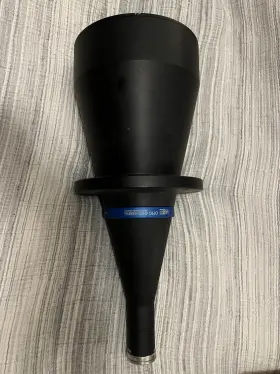
( Brand: The Telecentric Company ), ( Manufacturer Part Number: TC23110 ), ( Country/region Of Manufacture: United States )
Review THE TELECENTRIC COMPANY Used Lense Opto Engineering
The Telecentric TC23110 lens, manufactured by Opto Engineering, is a versatile and high-performance opto-mechanical component designed for various industrial applications. This lens stands out due to its telecentric design, which guarantees a constant object image magnification and parallelism along the whole optical axis. This attribute is particularly valuable in metrology, machine vision, and robotics industries, where precise measurements and object position sensing are crucial.
The TC23110 lens is characterized by a focal length of 31 mm and a field of view of approximately 25.8 . This combination allows it to capture a substantial area of an object while maintaining its magnification and parallelism properties. The lens features a 1/3" C-Mount threading, enabling it to be easily mounted on various imaging systems.
Made of high-quality optical glass, the TC23110 lens delivers superior image quality, with high resolution and low distortion. Its telecentric design also ensures that there is no image distortion due to object position changes. Additionally, this lens has a working distance of 125 mm, which provides ample space for mounting sensors and other components.
The TC23110 lens is designed to handle a wide range of lighting conditions. It has a high light transmission rate, allowing it to effectively capture images under various lighting scenarios. This makes it an excellent choice for applications where lighting conditions may vary.
The lens's robust and compact design makes it suitable for industrial environments. It is resilient to shocks and vibrations, ensuring that it maintains its precise optical properties even under harsh operating conditions. The TC23110 lens is also resistant to various temperatures, enabling it to function effectively in both hot and cold environments.
In summary, the Telecentric TC23110 lens by Opto Engineering is a high-performance and versatile opto-mechanical component. Its telecentric design, combined with its high resolution, low distortion, and wide field of view, make it an ideal choice for various industrial applications. Its robust design, high light transmission rate, and resistance to harsh environments further enhance its value.
Telecentric lenses, such as the TC23110 model from Opto Engineering, are a type of optical lens specifically designed to provide a telecentric projection of an object or scene. Telecentric lenses offer several advantages that make them a popular choice in various industries, particularly in metrology and machine vision applications. However, like any other optical component, they also come with their share of limitations. Let's explore the pros and cons of buying a telecentric TC23110 lens.
Pros:1. Elimination of Parallax: Telecentric lenses project an image of an object or scene onto the sensor without any parallax, which means that the size and shape of the image remain constant regardless of the object's position or the lens's angle of view. This feature is essential in metrology and machine vision applications where accurate and consistent measurement is required.
2. High Resolution: Telecentric lenses have a high resolution, which makes them ideal for capturing fine details and small features. This property is particularly valuable in industries such as semiconductor manufacturing, where the dimensions of the components are often very small.
3. Reduced Distortion: Telecentric lenses have minimal distortion, which is an essential factor in machine vision applications where image distortion can lead to measurement errors.
4. Easy Integration: Telecentric lenses are relatively easy to integrate into machine vision systems, as they provide a consistent image that can be easily processed by software.
Cons:1. Cost: Telecentric lenses are generally more expensive than other types of lenses due to their complex design and manufacturing process.
2. Limited Field of View: The telecentric design of the lens results in a narrower field of view compared to other lens types. This limitation may require the use of multiple lenses or the need to move the object being inspected to capture the entire area of interest.
3. Limited Depth of Field: Telecentric lenses have a limited depth of field, which means that the object being inspected must be at a specific distance from the lens to maintain focus. This requirement can be a challenge in applications where the object's position is not fixed or cannot be easily controlled.
Conclusion:Telecentric lenses, such as the TC23110 model from Opto Engineering, offer several advantages in terms of accuracy, resolution, and distortion reduction, making them an excellent choice for metrology and machine vision applications. However, they also come with limitations such as a narrow field of view, limited depth of field, and a higher cost compared to other lens types. Ultimately, the decision to invest in a telecentric lens depends on the specific requirements of your application and the trade-offs you are willing to make. If accurate measurements of small features with minimal distortion and parallax are essential, then a telecentric lens may be the best choice for your application. If, on the other hand, a wider field of view or a larger depth of field is necessary, then you may want to explore other lens types.
Details:
Used Opto Engineering TC23110 lense.
part #: tc23110 price
- $1100.00
specifications detectoimage:
- brand: The Telecentric Company
- manufacturer part number: TC23110
- country/region of manufacture: United States
general detectoimage:
- Test, Measurement Inspection > Cameras Imaging > Other Cameras Imaging
- condition: Used
seller detectoimage:
- city: Zachary, Louisiana
- rating: 100.0%
- # reviews: 20
shipping detectoimage:
- cost: $44.89
- carrier: USPS
- transit: 5-11 Days
- type: Calculated
- class: Standard
- service: USPS Ground Advantage
payments detectoimage:
- credit card: Discover
- other
- wallet: Google-pay
offer detectoimage:
- sold: 0
- options: Ship-to-home
- availability: In Stock
- quantity: 1
- started: September 11, 2025
returns detectoimage:
- policy: No Returns
The Telecentric Company TC23110 Is Similar To:
- Opto Engineering Tc23012 2 3 F 14 53.9 Mm C-mount Telecentric Lens (25.6% similar) The pictures are of The actual item being sold. $15 shipping all 50 states. Opto engineering TC23012 2/3 F/14 53.9MM c-mount Telecentric lens this listing is for one lens.: These are brand new...(September 6th, 2024)
- Opto Engineering Tc23024 2 3 F 8 67.2 Mm C-mount Telecentric Lens0 (25.6% similar) Working distance 67.2MM. Mount c-mount. No other lenses can offer The same optical performances regarding Disinterest and distortion. TC23024 technical specifications. Opto engineering TC23024: bi-Telecentric lenses for sensors up to 2/3...(December 30th, 2024)
- Moritex Sod-10x Used And Tested High Magnification Telecentric Lens (28.6% similar) The purchase history link on left side of page. Package content. Used tested Morita's SOD-10X high magnification Telecentric lens lens. Do remember sign your rma# on The front of package. Return items should include The original packaging and all accessories. Product feature...(January 16th, 2025)
- Opto Engineering Tc23120 Telecentric Lens For Vision Systems (26.9% similar) Explore The precision of opto engineering with TC23120 Telecentric lens, designed specifically for vision systems. Its Telecentric design minimizes field curvature and chromatic aberrations, providing a flat sharp focus across The entire sensor. This unit boasts high optical quality, ensuring...(February 11th, 2025)
- Computar Tec-m2065mp Used And Tested Telecentric Lens 2x65mm (33.6% similar) All shipping charges are not negotiable. The purchase history link on left side of page. Do remember sign your rma# on The front of package. Used tested computer ETC-M2065MP Telecentric lens 2X65MM 2X65MM. About technology. Telecentric lenses are ideal for tasks where measurement...(February 19th, 2025)
- Opto Engineering Tc12120 Telecentric Lens 0.052x Mag 8.0mm Img Circle Wf n 8mm (23.4% similar) Gorgeous Telecentric lens from The leader in Telecentric engineering. 2 working distance: distance between The front end of mechanics and object. I have some mounts for These lenses, let me know if you're interested. I will pack The lens well. Set this distance within 3% of The nominal...(March 3rd, 2025)
- Opto Engineering Tc12096 Telecentric Lens 0.068x Mag 8.0mm Img Circle Wf n 8mm (23.4% similar) I have some mounts for These lenses, let me know if you're interested. I will pack The lens well. Typical average production values and maximum guaranteed are listed. Excellent resolution for high cameras. Specs are in The images above, some repeated here for convenience...(March 3rd, 2025)
- Opto Engineering Tc12080 Telecentric Lens 0.080x Mag 8mm Img Circle Wf n (24.4% similar) 4 maximum angle between chief rays and optical axis on The object side. Typical average production values and maximum guaranteed are listed. Specs are in The images above, some repeated here for convenience. Key advantages high Disinterest for thick object imaging...(March 3rd, 2025)
- Opto Engineering Optical Imaging Technologies Oie Tccx100-g Coaxial Telecentric Lens For 2 3 Sensors New In Box (18.4% similar) Opto engineering TCCX100-G coaxial Telecentric lens for 2/3 sensors new in box, actual item shown, huge savings sells over $2,600 msrp brand new in original factory packaging, please view photos thoroughly to make sure this is The correct product you before purchase any questions...(March 19th, 2025)
- Opto Engineering Tc12056 1 2 F 8 157.8 Mm C-mount Telecentric Lens (25.6% similar) It boasts advanced features such as high resolution, fast frame rates, and sensitivity, making it suitable for demanding imaging tasks. This camera is part of opto engineering's lineup reliable and precise imaging solutions. The opto engineering TC12056 is a high-performance camera designed for...(March 30th, 2025)
- Vst Vstcm022150 s Used And Tested Vs-tcm022-150 s Telecentric Lens 2 3 Inch 0.22x Aperture (30.9% similar) This vst VS-TCM022-150/S lens ensures low distortion imaging for high-accuracy inspections. Product specifications. Used tested vst VS-TCM022-150/S Telecentric lens 2/3 inch 0.22X aperture aperture. Ideal for measurement systems and machine vision setups. Do remember sign your rma# on...(June 30th, 2025)

1 offer $1100.00 USD
- Used. Offer #1 priced at $1100.00 + $35.47 delivery = $1135.47* total. +$35.47 shipping